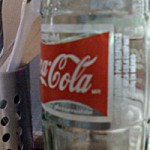
 I had noticed for some years that it was increasingly common to see, in the Mexican food sections of most local grocery stores, stocked in amongst the numerous flavors of Jarritos soda, a few glass bottles (the old-time returnable kind) of Coke. Mexican Coke. I never really “got it” or, frankly, cared too much to figure out what might be different about it and why it would be sold here, but lately it seems that the Cuba Libre (more commonly known simply as a Rum-and-Coke, or, if you prefer, a Rum-‘n’-Coke) is becoming trendy… for some reason. But along the way to that discovery, I also learned what’s different about Mexican Coke and why people, especially those who are used to it, would bother to buy it instead of the American version. The recipe still includes cane sugar.
Yes, although we’ve had “Coke Classic” here in the U.S. since the Coca-Cola company gave up on the insipid “New Coke” concept (although, interestingly, you can still buy it as “Coke II” in certain parts of Chicago), it’s not really the original formula, and not just because it doesn’t include cocaine. (I’m not talking that original here.) The U.S. version had the cane sugar replaced with America’s most beloved ingredient, high-fructose corn syrup, in the mid-1980s, around the same time that particular ingredient started showing up in everything. Click the link above to learn more about why Americans, or at least American corporations, love the stuff so much. It’s also worth checking out some of the commentary on the failed 1985 launch of New Coke and the reintroduction, a few months later, of Coke Classic. One almost has to wonder if the whole New Coke thing wasn’t just a risky ploy to ultimately get away with switching Coke Classic from cane sugar to corn syrup, since this was the moment when that transition occurred. Perhaps going straight to HFCS would have enraged customers, since it does taste slightly different, but the few months enduring the original drink’s miserable replacement made Coke Classic seem great, even if it was slightly different than before. But I digress… (Then again, isn’t digression the defining characteristic of this blog?)
Tonight SLP and I decided to try the “traditional” Cuba Libre, not just the college freshman’s intoxicant of choice, so although we still lamed out on the rum with Bacardi, we got a bottle of Mexican Coke, and took the extra step of including a lime wedge in the drink.
I didn’t actually try any of the Mexican Coke on its own, since I needed all of it for the mixed drinks, but even with the rum and the lime mixed in, I could tell the difference in the Coke. The drink overall lacked the cloying, slightly chemical-y taste I am now accustomed to in Coke. For a moment I had a flashback to the taste of my youth (minus the rum, of course). I look forward to trying a bottle of Mexican Coke on its own soon, preferably consumed straight from the bottle, since they’re the same shape and thickness as the old returnable bottles of yore… just slightly larger, since the Mexican bottles hold 500 mL (16.9 oz) instead of 16 oz.
I’ve noticed that Mexican Coke is getting easier and easier to find in the U.S. these days, so for those of you who, like me, are old enough to remember (though you may have long since forgotten it) the taste of pre-corn syrup Coke, I recommend picking up a bottle sometime soon!

 With Wimbledon underway and the Olympic Trials picking up speed, SLP and I have been watching a lot of sports on NBC this week. And the most breathless, repetitive story throughout has been the “marvel” of 41-year-old swimmer Dara Torres. 41. It is impossible for an NBC sportscaster to mention Dara Torres (41) without stating that she is 41. 41.
 Know
Know